Fast Carbs, Slow Carbs by David A. Kessler M.D
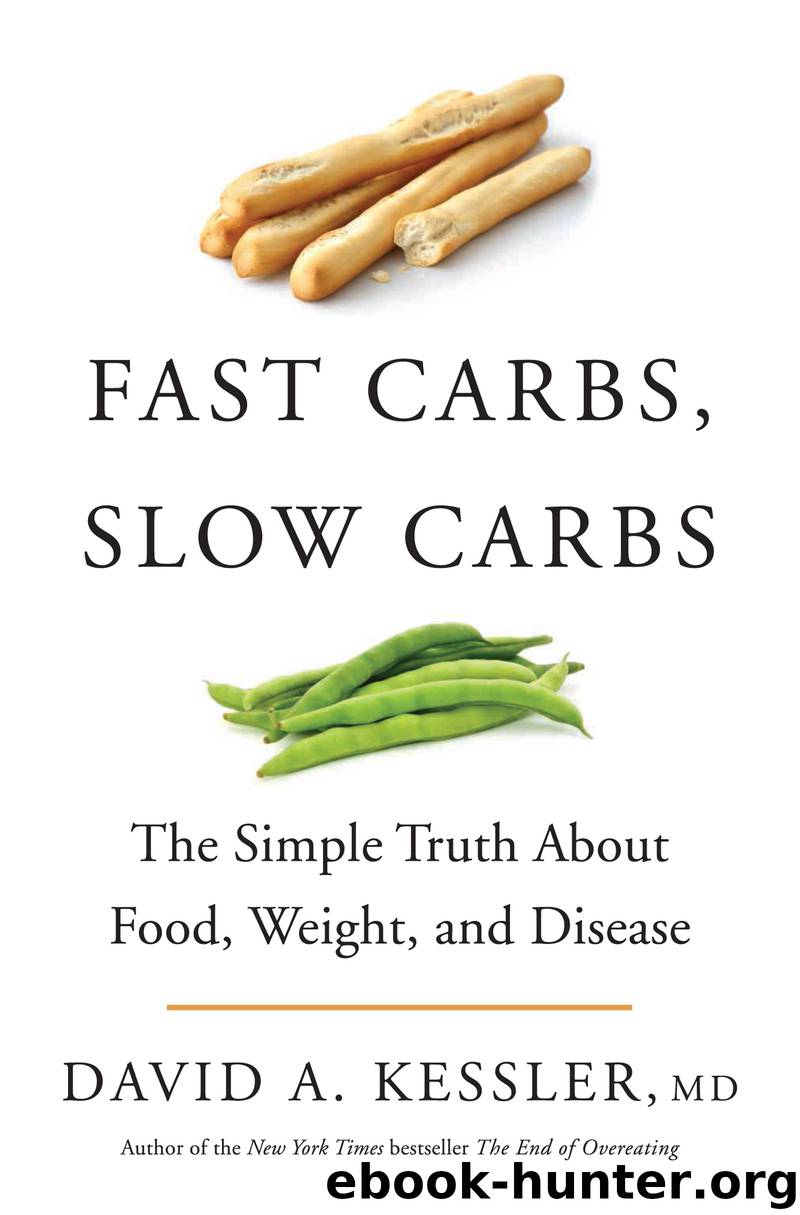
Author:David A. Kessler, M.D.
Language: eng
Format: epub
Publisher: HarperCollins
Published: 2020-02-13T00:00:00+00:00
Epilogue
In the Public Interest: Changing Our Food Environment
The industry culpability in promoting fast carbs emerges clearly in this story. But I tried to give companies the benefit of the doubt when I asked a spokesperson at General Mills about the effects of its products. Surely, I suggested, the industry had considered the weight and metabolic challenges most people face and recognized that consumers should be markedly reducing their consumption of rapidly absorbable glucose. Hadn’t they?
My wishful thinking was revealed when the company responded to my queries with the claim that “overall, food patterns and dietary habits are more relevant to maintaining healthy blood glucose levels, rather than any single food.” To me, that was another way of saying, “We aren’t responsible for what you eat, even though we flood the supermarket shelves with excess amounts of rapidly absorbable starches.”
The reality is that these enormous companies can only defend their products if they are going to survive. It’s just not possible to make the same profits by selling broccoli, strawberries, and rolled oats. They are going to keep urging us to eat their processed foods until they are forced to change by public demand and government action. What can be done?
First, education. We have to make all Americans aware of the dangers of rapidly absorbable predigested starch and its omnipresence in our food chain. That awareness will spur consumer and voter demand for new products.
Second, government action. The dietary guidelines designed to help consumers make healthy choices must change. We should establish a National Institute of Nutrition to study this issue, conduct rigorous research, and create accurate, easy-to-understand recommendations that cut through often contradictory and confusing arguments. The federal government spends a woefully inadequate sum on nutrition research, especially by contrast with national spending on candy purchases, which is about $40 billion per year.
Can these measures produce a massive shift in our eating habits? It’s a tall order, and it’s important to note the socioeconomic factors involved in such a shift. Right now, it is more expensive to eat healthy unprocessed foods than processed starch-heavy foods. Those with discretionary income will be able to change their patterns more easily; those with limited means face an even greater challenge. What can government do to help all Americans? What industry regulations are needed to force this change? These are urgent questions that demand comprehensive answers and decisive action.
The choices we need to make as individuals to achieve better health are clear, but the path to national health policies still needs to be mapped. Without doubt, to improve and save lives, we need to chart that path now.
Download
This site does not store any files on its server. We only index and link to content provided by other sites. Please contact the content providers to delete copyright contents if any and email us, we'll remove relevant links or contents immediately.
Men In Love by Nancy Friday(5292)
Everything Happens for a Reason by Kate Bowler(4783)
The Immortal Life of Henrietta Lacks by Rebecca Skloot(4639)
Why We Sleep by Matthew Walker(4482)
The Sports Rules Book by Human Kinetics(4448)
Not a Diet Book by James Smith(3480)
The Emperor of All Maladies: A Biography of Cancer by Siddhartha Mukherjee(3206)
Sapiens and Homo Deus by Yuval Noah Harari(3109)
Day by Elie Wiesel(2811)
Angels in America by Tony Kushner(2685)
A Burst of Light by Audre Lorde(2634)
Endless Forms Most Beautiful by Sean B. Carroll(2509)
Hashimoto's Protocol by Izabella Wentz PharmD(2394)
Dirty Genes by Ben Lynch(2339)
Reservoir 13 by Jon McGregor(2334)
Wonder by R J Palacio(2252)
And the Band Played On by Randy Shilts(2240)
Stretching to Stay Young by Jessica Matthews(2117)
The Immune System Recovery Plan by Susan Blum(2082)
